

ADHD vs. Executive Functioning Difficulties: How Can Parents Tell What Support Their Child Needs?
Your child has practised the same math problems several times, completed extra worksheets, and reviewed the lesson with you. Yet

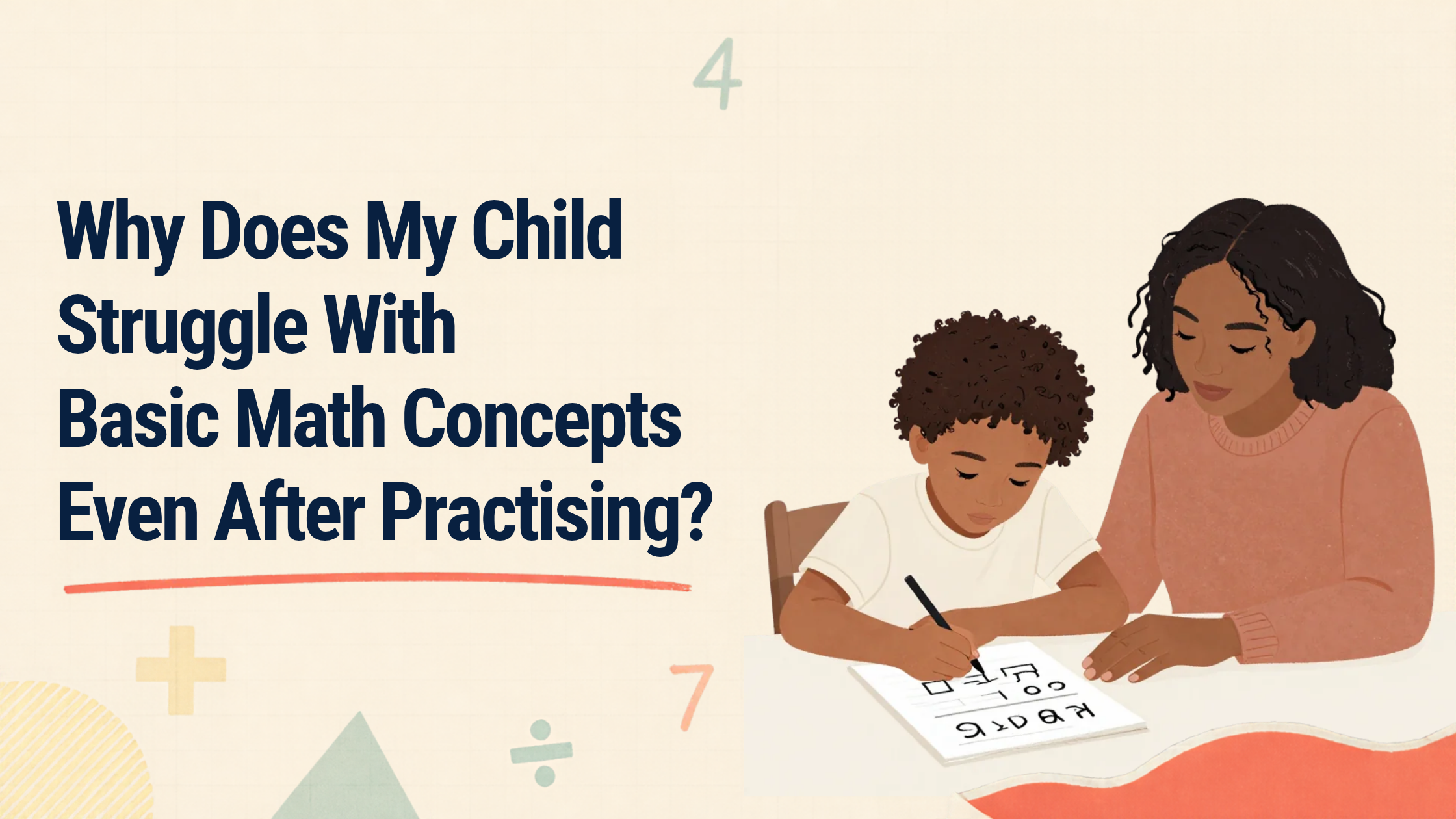
Your child has practised the same math problems several times, completed extra worksheets, and reviewed the lesson with you. Yet when faced with a similar question the next day, they seem unsure where to begin. For many parents, this can be frustrating and confusing. If a child is putting in effort, why aren’t the concepts becoming easier?
Persistent difficulty with mathematics does not necessarily mean a child is unwilling to learn or lacks ability. Sometimes the problem lies in how foundational mathematical concepts are understood, remembered, or applied. Understanding the reasons behind these challenges can help parents identify when additional practice is useful and when a different learning approach may be needed.
Mathematics involves more than memorizing numbers and formulas. Children must develop number sense, understand relationships between quantities, recognize patterns, and connect mathematical ideas to problem-solving situations. When these foundational skills are not fully developed, more advanced lessons can become increasingly difficult.
For example, a child may memorize an addition fact without understanding how quantities combine. They might answer familiar questions correctly but struggle when the same concept is presented in a different format. Common factors that can contribute to math difficulties include:
Children develop mathematical understanding at different rates, and occasional mistakes are part of learning. However, persistent difficulties across multiple lessons may indicate that a child needs more targeted support. Parents may notice that their child:
These signs do not automatically indicate a learning disability. They suggest that it may be helpful to look more closely at the child’s understanding and the methods being used to teach the concepts.
Practice is important, but repetition alone may not resolve a misunderstanding. If a child has learned a procedure without understanding the underlying concept, completing more worksheets may reinforce the same approach without addressing the actual difficulty.For example, a student might memorize the steps for subtraction with regrouping but not understand place value.
When the numbers change or a word problem requires the same skill, the student may struggle to apply what they have practised. Effective mathematics instruction should connect procedures with conceptual understanding. This can involve using visual representations, manipulatives, number lines, and real-life examples to demonstrate why a mathematical process works. When a child continues to struggle despite consistent practice, Math Remediation Programs can provide a more structured approach to identifying and strengthening missing foundational skills.
Helping a child develop mathematical understanding often requires changing how a concept is presented rather than simply increasing the number of questions.
Shopping, cooking, measuring, and dividing objects into groups can help children connect abstract numbers to real quantities. For example, measuring ingredients can introduce fractions and comparisons, while dividing snacks into equal groups can demonstrate early multiplication and division concepts.
Instead of asking only for the correct answer, invite your child to explain how they solved the problem. Questions such as “How did you figure that out?” or “Can you show me another way?” can reveal whether the child understands the concept or is relying on memorized steps.
Counters, number lines, blocks, diagrams, and other visual representations can make mathematical relationships easier to understand. These tools are especially useful when children find abstract calculations difficult.
When several foundational concepts are unclear, introducing too many new strategies at once can create confusion. Breaking learning into smaller steps allows children to build confidence and practise one concept before moving to the next.
Children who experience repeated difficulty with mathematics may begin to associate the subject with frustration or failure. A supportive environment that treats mistakes as part of learning can help children remain engaged and willing to try different approaches.
Sometimes persistent math difficulties are associated with a specific learning disorder involving mathematics, often referred to as dyscalculia. Dyscalculia can affect the development of number sense, arithmetic learning, and other mathematical skills. However, not every child who struggles with math has dyscalculia. Attention difficulties, gaps in instruction, language comprehension challenges, anxiety, and other learning factors can also affect mathematical performance.
Parents should avoid diagnosing a child based on a single symptom or online checklist. When difficulties persist and significantly affect learning, a qualified professional can help determine whether a formal assessment is appropriate. Educational intervention can focus on strengthening identified skills while families explore any additional assessment or support needs.
Extra practice generally focuses on repeating skills that have already been introduced. Math remediation takes a more targeted approach by identifying the foundational concepts a student has not fully understood. For example, a student struggling with fractions may actually need additional work on division, equal parts, or number relationships. Rather than concentrating only on the current classroom assignment, a Math Remediation Program can address earlier learning gaps that are making new concepts difficult.
| Extra Math Practice | Math Remediation |
|---|---|
| Reinforces previously taught material | Identifies and addresses underlying learning gaps |
| Often follows current classroom topics | May revisit earlier foundational concepts |
| Emphasizes repetition and familiarity | Emphasizes conceptual understanding and targeted instruction |
| Useful when a student needs reinforcement | Useful when repeated practice is not resolving persistent difficulties |
Parents may consider additional support when mathematical difficulties continue despite classroom instruction, homework assistance, and regular practice. Some indicators include:
A conversation with the child’s teacher can help identify specific areas of difficulty and clarify which strategies have already been tried. Where appropriate, specialized Math Learning Support in Montreal can help students strengthen foundational skills through structured instruction matched to their learning needs. Early attention to persistent difficulties may help prevent learning gaps from becoming more challenging as mathematical expectations increase.
At Strategic Learning Clinic in Montreal, we understand that children may struggle with mathematics for different reasons. Some need to strengthen foundational number concepts, while others require support with mathematical reasoning, problem-solving, or applying previously learned skills. Our Math Remediation Program focuses on addressing learning difficulties through targeted instruction that considers the student’s individual needs.
Rather than relying exclusively on repeated worksheets or memorization, the goal is to help students build stronger mathematical understanding and develop greater confidence in their learning. For families concerned about persistent math difficulties, identifying the underlying learning gaps can provide a clearer direction for support.
Start with an introductory call to discuss your teen's current challenges and the most appropriate next step.
Your child has practised the same math problems several times, completed extra worksheets, and reviewed the lesson with you. Yet
Your teenager sits in class, follows the lesson, and seems to understand the material. At home, they can explain what
When a child begins struggling at school, one of the first questions parents ask is: What kind of help do